
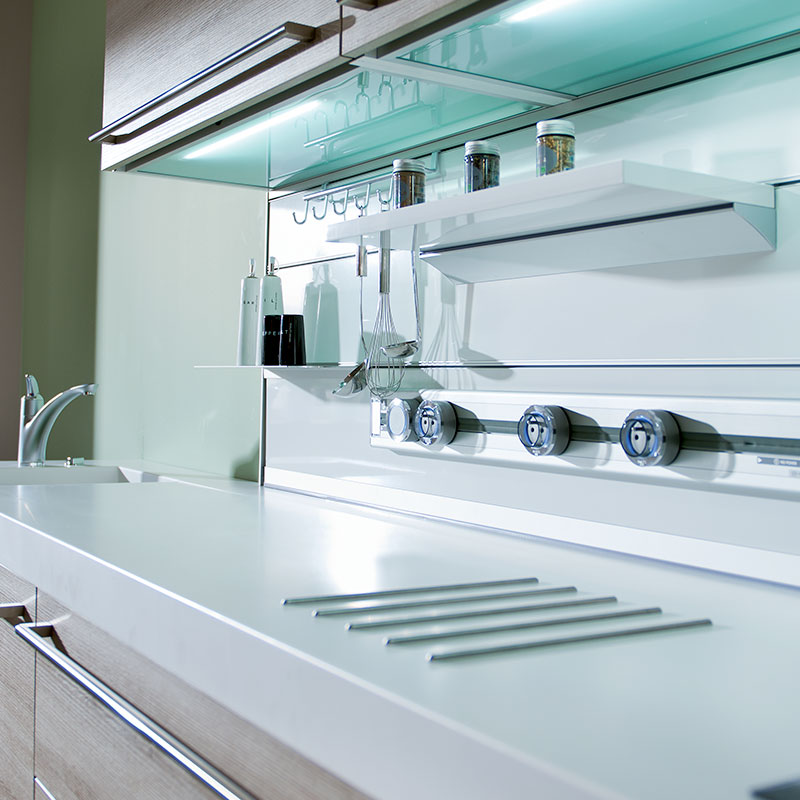
Power tracks & columns
Discover Eubiq power tracks and power columns, a stylish and modular solution that lets you install your sockets wherever you need them. Whether surface-mounted, recessed, or semi-recessed, Eubiq tracks allow you to easily add and reposition sockets and accessories in your kitchen, office, or professional spaces.
6 products
Sort by:
6 products


The designer socket track that revolutionizes your worktop
No more tangled cables or unsightly power strips. EUBIQ's E-Genesis track combines modular power supply, integrated cable management and a brushed aluminium design — for impeccable organization in kitchens, offices or professional spaces.
Why choose the E-Genesis track?
A complete modular system that combines three features rarely found on the market:
Integrated cable management
Slide excess cable into the dedicated compartment under the track. No more trailing wires, no more visual clutter.
Sockets repositionable at any time
Move, add or remove your sockets on the track without any tools. Flexibility at your fingertips.
Brushed aluminium design
A sleek and elegant finish that blends perfectly into a contemporary interior — kitchen, office or living room.
Which length to choose?
The E-Genesis track is available in three standard lengths, each offering a specific number of slots for your EUBIQ sockets and accessories:
Ideal for a small worktop or compact desk
The format suited for most kitchen splashbacks
For large spaces and intensive professional use
E-Genesis tracks cannot be cut and are not designed to be connected together. For a custom length or lengths greater than 120 cm, please consult our range of designer cable trunking and power strips.
Technical specifications
For what uses?
Thanks to its modularity and discreet design, the E-Genesis track adapts to a multitude of environments:
Kitchen splashback
Power your food processor, kettle or toaster without visible cables.
Home or professional office
Neatly manage the power supply for your IT setup.
TV unit / home cinema
Group all the sockets for your multimedia equipment on a single track.
Hotels, restaurants, coworking spaces
A neat and scalable installation for demanding professional environments.
Workshops and technical spaces
A robust and certified track for intensive daily use.
How to install the E-Genesis track?
The installation is accessible, but must be carried out or validated by a competent person for the electrical connection.
Choose the power supply side
Left or right depending on the selected reference, based on the location of your wall cable socket.
Position the track on the wall
At the desired location (splashback, desk top, etc.) and mark the fixing points.
Screw the track onto the surface
Using the fixings provided on the aluminium profile for this purpose.
Connect the power supply
By a qualified electrician if you are not authorized.
Insert your sockets and accessories
In the location of your choice along the track — and reposition them whenever you want, without any tools.
Store the cables
Slide excess cables into the integrated storage compartment under the track.
Tip: Remember to anticipate the power supply side before ordering your track. Once in place, the connection direction is not interchangeable without changing the reference.
Compatible accessories
The E-Genesis track accommodates all the sockets in the EUBIQ range, regardless of their socket type or the country they are intended for. It is not limited to French Type E sockets. You can also add EUBIQ USB chargers:
All EUBIQ sockets
French FR3 and FR4, Schuko GS3, British BS3, international ITL3 and Italian ITA3 sockets: choose the model suited to your device's plug. All these models fit on the same track.
USB-A and USB-C chargers
Charging smartphones, tablets and connected accessories.
International sockets
Practical for spaces welcoming foreign visitors.
USB sockets and chargers are sold separately. RJ45 modules cannot be installed on the E-Genesis: to integrate RJ45 connections, choose the SH1 track.
Frequently asked questions
Can several E-Genesis tracks be connected together to cover a greater length?
No. E-Genesis tracks are not designed to be interconnected. For longer or custom-made installations, we recommend turning to the range of designer cable trunking and power strips available on our website.
Can the E-Genesis track be cut to the desired length?
No, the E-Genesis track cannot be cut. It is offered in three fixed lengths: 60 cm, 90 cm and 120 cm. Choose the length best suited to your space.
Are the sockets included with the track?
No. The E-Genesis track is sold alone, without accessories. All EUBIQ sockets, regardless of their type, as well as EUBIQ USB chargers, are available separately in our shop and fit freely into the track.
Can an RJ45 connection be added to the E-Genesis?
No. The E-Genesis does not allow the installation of RJ45 modules. To integrate RJ45 connections, choose the SH1 track.
Is the E-Genesis track available in black?
Yes! In addition to the brushed aluminium finish, the E-Genesis track is also available in a brushed black finish to match dark interiors or contemporary black kitchens.
What is the difference with a classic electrical plasterboard track?
An electrical plasterboard track is used for routing conduits in a partition. The E-Genesis track, on the other hand, is a modular and designer surface-mounted power supply system, intended for visible and daily use on a worktop, splashback or desk.
Practical information
- BrandEUBIQ
- WeightVaries depending on the track length
- Product dimensions62 × 10 × 12 cm (60 cm model)
- FinishesBrushed aluminium — Brushed black
- Lengths60 cm / 90 cm / 120 cm
- InstallationSurface-mounted, screwed to the wall
No more tangled cables and unsightly power strips.
The EUBIQ E-Genesis track: sockets where you need them, cables that disappear, an interior that can finally breathe.


The wall socket reinvented, by Eubiq
No more unsightly power strips on the floor. The SH1 track transforms your wall into an intelligent power hub: add, move, or remove your sockets and chargers as you wish, on a slim and discreet brushed aluminium profile. Available from 60 to 120 cm, in brushed aluminium or brushed black finish.
Why choose the SH1 track?
Modular placement
Add or reposition your sockets, USB chargers and accessories wherever you like along the entire length of the track. Your installation evolves with your needs.
4 lengths available
60 cm, 80 cm, 100 cm or 120 cm: choose the dimension that suits your space. The track can even be shortened by up to 9 cm.
Two refined finishes
Brushed aluminium for bright and contemporary interiors, or brushed black for a more modern and industrial touch.
Connectable tracks
Connect several tracks together using the connectors built into each end, to cover large lengths without interruption. For custom lengths with angles, choose the SH1 conduit supplied bare and fully configurable, in the "Custom Track Conduit" collection.
Kitchen hooks and bars
A groove under the track allows you to clip on hooks or bars to hang your kitchen utensils. Dual function, zero clutter.
RJ45 compatible
Up to 3 network ports available via the DS4 box (sold separately). Power and connectivity combined on a single track.
Technical specifications
Capacity by length
| Length | Sockets | Recommended use |
|---|---|---|
| 60 cm | 5 | Small worktop, bedside, compact desk |
| 80 cm | 8 | Standard desk, medium-length kitchen backsplash |
| 100 cm | 10 | Large kitchen, TV unit, shared workspace |
| 120 cm | 13 | Large backsplash, meeting room, professional counter |
To create custom lengths with angles, choose the SH1 conduit, supplied bare and fully configurable, in the "Custom Track Conduit" collection. This is a modular solution, distinct from the SH1 track presented here in standard lengths.
Where to install the SH1 track?
Kitchen backsplash
Multiply your power points above the worktop. Also hang your utensils under the track using the integrated groove.
Desk and remote working
Power PCs, screens, lamps and chargers from a sleek track, positioned high on the wall or at the back of the desk.
TV unit and living room
Integrate the track behind or under your TV unit to centralise power cables discreetly.
Professional spaces
Meeting rooms, counters, showrooms: the SH1 offers clean and scalable power in all work environments.
Installation in 4 steps
Choose length and finish
Assess the available space on your wall or furniture and select the appropriate length (60, 80, 100 or 120 cm). The track can be shortened by up to 9 cm if necessary.
Fix the surface-mounted track
Screw the track directly onto your wall or support. The surface-mounted installation ensures a solid and durable hold.
Connect the power supply
The track has a connection at each end. Leave the electrical connection to a qualified electrician. Several tracks can be connected together.
Clip on your sockets and accessories
Insert your Eubiq sockets, USB chargers or blank covers into the desired slots. Reposition them at any time according to your evolving needs.
⚠️ Electrical connection must be carried out by a qualified electrician, in accordance with current standards. Sockets, USB chargers and accessories are sold separately.
Compatible accessories
The SH1 track accommodates all EUBIQ sockets, not just French Type E sockets: French FR3 and FR4, Schuko GS3, British BS3, international ITL3 and Italian ITA3. Choose the model that suits your device's plug.
USB-A and USB-C for charging smartphones and tablets directly from the track
Network connectivity — up to 3 ports available (sold separately)
Clip into the lower groove of the track — ideal for the kitchen
To neatly cover unused slots
Frequently asked questions
Can the SH1 track be cut to the desired length?
Yes, the SH1 track can be shortened by up to 9 cm maximum. This operation involves removing the RJ45 slots located at the ends. For custom lengths with angles, choose the SH1 conduit supplied bare and fully configurable, in the "Custom Track Conduit" collection.
Can several SH1 tracks be connected together?
Absolutely. Each track is equipped with a connection at each end, allowing several tracks to be connected together to cover large lengths. For a custom configuration with angles, choose the SH1 conduit supplied bare, to be assembled according to your needs in the "Custom Track Conduit" collection.
Is the SH1 track suitable for installation in a kitchen?
Yes, with its IP40 protection rating, it is suitable for use in the kitchen (excluding areas of direct water projection). The groove under the profile allows you to hang bars and hooks for your utensils.
What is the difference between the brushed aluminium and brushed black finish?
It is purely an aesthetic difference. Both versions share the same technical specifications. The brushed aluminium finish blends into bright kitchens and contemporary interiors, while brushed black provides a more modern and industrial touch.
Are the sockets included in the delivery?
No. The SH1 track is sold without accessories. Sockets, USB chargers and other modules are to be ordered separately from the Eubiq range.
Product information
The Eubiq SH1 track is the promise of an interior that is finally organised, without compromising on style. Infinitely modular, available in two refined finishes and designed to last — it adapts to your space, not the other way around.
Discover compatible accessories


The power track designed to blend into your furniture
No more unsightly power strips. The RH2 track is designed to be recessed into your furniture and accepts sockets, USB chargers, and accessories that can be positioned anywhere along its length. Available in 4 lengths and 2 finishes.
Why choose the RH2 track?
The track is recessed into the furniture and its front face protrudes by only 2 mm from the support. The 8 cm corresponds to the total width of the track, not its protrusion.
Change the location of your sockets without drilling or rewiring. Reposition or add modules at any time, without tools.
Add modules as needed without replacing the track. 2P+T sockets, USB chargers, RJ45 boxes… everything is compatible.
Brushed aluminium, IEC/EN 61534 certified, 32 A conductors. Used in high-end hotel and commercial projects.
Two finishes to suit any interior
Bright and discreet, perfect for white kitchens, light-colored furniture, and minimalist spaces
Elegant and modern, ideal for industrial interiors, dark offices, or black kitchens
Complete technical specifications
Available lengths and slots
The RH2 track is available in 4 standard lengths. The longer the track, the more slots you have to clip on your compatible EUBIQ modules.
| Track length | Socket slots | RJ45 slots |
|---|---|---|
| 60 cm | 5 slots | Up to 3 |
| 80 cm | 8 slots | Up to 3 |
| 100 cm | 10 slots | Up to 3 |
| 120 cm | 13 slots | Up to 3 |
For what applications?
The RH2 track is designed to be recessed into furniture. Its modular design allows you to integrate the electrical power supply into the furniture, both in residential and professional environments.
Unlike a classic power strip, the RH2 recessed power track blends into your furniture. Its 8 cm wide front face remains visible and protrudes by 2 mm from the support. The recessing depth is 3.4 cm. The result is clean, professional, and remarkably discreet.
How to install the RH2 track in a piece of furniture?
Choose from the standard lengths (60, 80, 100 or 120 cm) according to the available space and the desired number of sockets. For a custom length, choose the RH2 conduit in the "Custom Track" collection.
Check the material of the furniture and the compatibility of the mounting method before making the cut according to the installation guide: 7 cm of recessed width and 3.4 cm of depth.
Insert the track into the cut in the furniture and fix it according to the installation guide. The support depends on the material of the support and the chosen mounting method. Once recessed, the front face of the track protrudes by 2 mm from the support.
Via one of the two connections located at each end of the track (or both if you connect several tracks together).
2P+T sockets, USB chargers, universal sockets, RJ45 boxes… anywhere you need them, at any place on the track.
Modularity: compose your track as you wish
This is the main asset of the EUBIQ system: total modularity. The RH2 track is not delivered with fixed sockets. You freely choose the modules to clip on it according to your current needs, and you can reposition them or add them at any time, without tools.
Type E, French standard
For international use
Built-in fast charging
DS3 or DS4, up to 3 per track
Integrated network connectivity
The RH2 track is not limited to electrical power. You can integrate up to 3 RJ45 slots by replacing the neutral covers located at the ends with DS3 or DS4 boxes (sold separately). An ideal solution for fixed workstations, meeting rooms, or offices where a wired connection is essential.
Connect several RH2 tracks together
Each RH2 track is equipped with an electrical connection at each end, allowing you to connect several tracks in a row. To create an installation at the desired length, choose the RH2 conduit in the "Custom Track" collection, rather than limiting yourself to the standard lengths presented on this data sheet.
Certification and safety
International standard for conduit and power track systems
Compliance with European electrical safety directives
Protection against the penetration of solid bodies greater than 1 mm
Oversized compared to the power supply (16/20 A) for enhanced safety and durability
Additional information
The EUBIQ RH2 recessed power track is the perfect combination of sleek design and functionality thought out down to the smallest detail. Install it once, adapt it for life.
Kitchen furniture, desk, or professional furniture: discreetly integrate the electrical power supply into your furniture.
Discover compatible modules


A modular track with two integrated USB ports
On your desk or in your furniture, group the power supply for your devices and the charging of your smartphones and tablets. The Genesis Track combines a 65.6 cm track with two integrated USB ports and a pre-installed 1.5 m cable. Choose a surface-mounted or semi-recessed installation and a brushed titanium or brushed black finish.
Why choose the GT 1.0 - Genesis?
Mount the track on the surface or integrate it semi-recessed according to your project. One model for two ways to arrange your space.
Two USB ports of 2.1 A each, or 4.2 A in total, allow you to charge your smartphones and tablets directly from the track.
The track accommodates up to five EUBIQ sockets. Design your installation according to the devices to be powered and position your sockets along the track.
The GT 1.0 is pre-wired with a 1.5 m cable in 3G2.5 mm², delivered without a male plug. Plan the connection suitable for your installation.
Two finishes for your interior
A brushed finish on an aluminum track, for a sober integration into your interior.
A dark finish to match your furniture and equipment.
Complete technical specifications
A compact format for your everyday devices
The GT 1.0 - Genesis is presented as a 65 cm model; its technical length is 65.6 cm. It combines up to five sockets and two integrated USB ports.
| Track length | Maximum capacity | Integrated charging |
|---|---|---|
| 65.6 cm | 5 sockets | 2 USB ports of 2.1 A |
How to install the GT 1.0 - Genesis?
Surface-mounted or semi-recessed, according to your interior design and the available support.
Consult the GT 1.0 documentation to prepare the support and perform the fixation corresponding to the chosen installation method.
The 1.5 m cable in 3G2.5 mm² is already installed on the track, but it does not include a male plug. The connection must be carried out by a qualified electrician.
Design your installation with GSS-compatible EUBIQ sockets, up to five sockets. The two USB charging ports are integrated into the track.
Modularity and USB charging
The Genesis Track allows you to position your sockets according to your needs, while its two USB ports remain integrated into the track.
Choose your sockets from the GSS-compatible EUBIQ range. The track can accommodate up to five sockets.
Charge your smartphones and tablets thanks to the two ports of 2.1 A each, without adding a separate USB module.
Additional information
A track to power your devices and charge your smartphones and tablets, with two USB ports already integrated.
Choose your finish and installation method: surface-mounted or semi-recessed.


The most elegant vertical power distribution for your professional spaces
Brushed titanium or brushed black aluminum finish, tool-free interchangeable Eubiq modular sockets and 4 USB ports. A freestanding column that powers up to 8 devices simultaneously, on both sides.
The essentials at a glance
4 advantages that make the difference
Total modularity
Each socket can be snapped in, moved and removed without tools. Adapt the column in real time with Schuko (Europe), UK (Great Britain) or international sockets. Ideal for hospitality and events.
Double-sided: up to 8 sockets
4 slots per side to power up to 8 devices simultaneously. Perfect for a central conference table or a counter serving two distinct areas.
4 USB ports
Two USB ports per side to charge smartphones and tablets without cluttering the sockets.
Integrated cable management
The side grooves channel and conceal excess cables. The installation remains neat, secure and professional, even with several connected devices.
Designed for public-facing spaces
In a professional space open to the public, power needs are varied and often unforeseen. The double-sided architecture of the TT 1.0 allows it to serve several users simultaneously on both sides of the column.
Hotels and lobbies
Welcome international guests with universal sockets adaptable to every nationality.
Meeting rooms and seminars
Central power supply for participants around a conference table.
Bars and lounge areas
Discreet device charging with a premium brushed titanium design.
Coworking and open spaces
Vertical distribution to eliminate power strips on the floor and trailing wires.
Showrooms and exhibitions
Elegant power supply for interactive presentations and touchscreens.
Complete technical specifications
Simplified commissioning
Position
Place the column in the desired location. Its stable aluminum base ensures a solid footing on any flat surface.
Connect
Plug the power cable (2.95 m) into a wall socket. The connection to the electrical network must be carried out by a qualified electrician.
Configure
Insert your choice of Eubiq socket modules — tool-free, in a few seconds. Adapt the configuration at any time.
What you need to know before ordering
Delivered without sockets
Eubiq socket modules are purchased separately, allowing you to build the exact configuration you need — in socket type, quantity and nationality. If your needs change, you do not replace the column: you simply adapt the modules.
Available in brushed aluminum or brushed black
The column is available in two finishes to blend into designer environments.
Simple installation
The column is delivered with a Schuko-compatible French plug: simply plug it into a standard socket to use it. Eubiq socket modules can be added, moved and configured without tools, allowing each user to easily adapt the column to their needs.
Frequently asked questions
Is the column compatible with British or international sockets?
Yes. The Eubiq system accepts a wide range of socket modules, including Schuko (Europe), UK (Great Britain) and international formats. You assemble your configuration according to the actual needs of your space.
What is the maximum supported power?
The column supports a voltage of 250 V with a maximum current of 20 A, or a maximum power of 5,000 W. Sufficient to power several professional devices simultaneously.
Can the USB ports charge tablets?
Yes, the built-in USB chargers are designed to power smartphones and touchscreens. For optimal charging of modern devices, check the amperage compatibility with the equipment used.
What is the difference between a column and a standard electrical column?
The column is a freestanding, placeable device, ideal for temporary or semi-permanent installation in the heart of a space. The standard column is generally fixed to the floor or ceiling. The TT 1.0 therefore offers greater placement flexibility.
Elegant, modular and designed for the demanding professional.
The TT 1.0 transforms electrical distribution into a real decorative asset.
The TT 1.0 electrical column is professional electrical power equipment. This product does not replace any electrical safety standard in force in your establishment.


The most elegant power track system on the market
Designer power track with modular sockets, tiltable aluminum profile at 60° or 90°, clamp-on mounting with no drilling required. Designed for training rooms, open-plan offices, modern offices, and coworking spaces. 2 m cable included, ready to use.
Key features at a glance
Two clamps are all you need to mount the track on any worktop up to 5 cm thick. Installation and removal in seconds.
Tilt the track to 60° for comfortable front access while seated, or to 90° for a vertical position against an edge or partition.
Two finishes to choose from: anodized aluminum or titanium, to match any modern professional environment.
DS3 enclosures accept two RJ45 inserts for network connectivity integrated directly into the track.
80 cm, 100 cm, 120 cm, 160 cm and 180 cm — suitable for all table, desk, and workstation sizes.
The track comes with a 2-meter cable, ready to be plugged into your existing electrical installation. No complex wiring required.
What is the VSF MC power track?
The VSF MC power track from EUBIQ is much more than a simple power strip. It is a power track system with a tiltable aluminum profile, available in several lengths (80 cm to 180 cm), designed to blend discreetly into your work surfaces without drilling or complex installation.
Thanks to its two-clamp mounting system, it can be installed on a desk, meeting table, or worktop in just a few minutes. The rotatable modular sockets (GS3, FR3-L, DS3 types) slide directly onto the track and can be oriented to suit your needs — a unique flexibility that appeals to interior designers and facility managers.
Complete technical specifications
Finishes and lengths
| Finish | Lengths |
|---|---|
| Titanium | 80, 100, 120 and 180 cm |
| Anodized aluminum | 100, 120, 160 and 180 cm |
For which spaces is it designed?
The VSF MC worktop power track is primarily designed for professional environments, but is also perfectly suited for discerning private users:
Dedicated power supply for each workstation, with no cables on the floor. Each participant has their own sockets, which can be repositioned at will.
A track mounted at each workstation, configurable to suit the needs of each employee.
Power supply for computers in computer labs, with quick installation and easy removal.
Premium aesthetics and quick installation — enhances the establishment's brand image.
A designer solution to replace standard power strips and neatly organize your workspace.
Installation in 4 steps
From 80 to 180 cm, select the dimension that matches your worktop and the finish that complements your furniture (anodized aluminum or titanium).
Secure the clamping clamps under the edge of your desk. No drilling required — compatible with worktops up to approximately 5 cm thick.
Clip the track onto the clamps and tilt it to the desired angle: 60° for front access, or 90° for a vertical position.
Plug the supplied 2 m cable into your wall socket. Then slide the GS3, FR3-L or DS3 modular sockets directly onto the track.
VSF MC Power Track vs. Other Power Tracks
Many power tracks exist (surface-mounted, recessed, kitchen-specific, etc.), but the EUBIQ VSF MC stands out in several practical ways:
Most competing tracks are fixed. The VSF MC adjusts to the user's ergonomics with two angles to choose from.
Unlike wall-mounted or recessed tracks that require construction work, the VSF MC can be installed and removed in seconds.
The EUBIQ ecosystem allows the track to adapt to evolving needs: add sockets, network modules, USB chargers, etc.
Far from the plastic look of standard power strips, the VSF MC enhances the aesthetics of any workspace.
Frequently Asked Questions
What is the difference between the 60° and 90° tilt?
At 60°, the track is tilted toward the user, making the sockets easier to access while seated. At 90°, it is vertical, ideal for installation against an edge or partition. The dimensions change slightly: H 9.1 × D 14.06 cm at 60° versus H 9.74 × D 6.74 cm at 90°.
What accessories can be used with the track?
The track accommodates compatible sockets and accessories from the EUBIQ range, which can be selected according to your power and connectivity needs.
Is the track compatible with RJ45 equipment?
Yes. DS3 enclosures can accommodate two RJ45 inserts to integrate your Ethernet network directly into the track without any additional visible cabling.
Can sockets be added to or moved on the track?
Absolutely. This is one of the major advantages of the EUBIQ system: the modular sockets are removable and can be repositioned anywhere along the track at any time, without tools.
Is the VSF MC compatible with standard power strips?
No, this system uses proprietary EUBIQ sockets. It is designed to replace standard power strips in professional environments, offering an incomparable level of finish and modularity.
What is the maximum load supported by the track?
The track operates at 220–250 V. The maximum load depends on the fuse of the electrical installation to which it is connected. It is recommended to follow the instructions of a qualified electrician to determine the circuit's capacity.
Additional Information
Understated, elegant, designed down to the last detail — the EUBIQ VSF MC track transforms any worktop into a professional power station without unsightly cables.
Training rooms, open-plan offices, home offices: the smartest solution to combine practicality, design, and connectivity.
Discover all variantsWhich power track is right for your space?
3 questions to identify the EUBIQ solution best suited to your layout, installation constraints, and aesthetic requirements.
Question 1 of 3
What type of installation are you planning?
This choice determines compatibility with your wall or furniture.
Question 2 of 3
What is your main priority?
Every track has its strengths. Let's identify the one that matters most to you.
Question 3 of 3
In what environment will the track be installed?
Daily use and the intended audience heavily influence the ideal format.
Our recommendations for you
Based on your answers, here are the solutions best suited to your situation.
Increasing the number of sockets without increasing the number of extension cords or floor blocks: that is exactly the promise of the power track. But between a recessed track, a surface-mounted track, and a power pole, the choice is far from obvious. Everything depends on your configuration, your furniture, and how you use them on a daily basis.
If you are here, it is likely that you have already identified the need. You know that standard power strips are no longer enough. The real question now is: which format should you choose? We’ll help you see things clearly with an objective comparison of EUBIQ solutions adapted to professional environments - offices, meeting rooms, and coworking spaces.
Why standard power distribution solutions are problematic
Let's be honest: in most offices, managing sockets is a permanent DIY job. Power strips piled under desks, cables snaking across the floor, extension cords running under carpets... The result? Tripping hazards, a poor visual appearance, and an unprofessional image, especially in an open-plan office or a meeting room that receives clients.
And then there are fixed wall sockets. They might have been well-placed on the day of installation, but as soon as workstations are rearranged - which happens often - they end up behind a cabinet or three meters away from the desk that needs them.
Cable ducts with integrated sockets? That is better in terms of functionality. But an electrical socket duct remains rigid in its configuration: the sockets are fixed in defined locations, and the aesthetic result often leaves something to be desired in a well-maintained space.
The real need, at its core, is simple: to be able to add or move a socket without heavy electrical work, without visible cables, while maintaining a clean and professional space. That is precisely where the power track changes the game.
Power track, power pole: what exactly are we talking about?
Before comparing, let’s lay the foundations. Because "power track" and "power pole" can remain vague if you have never handled these products.
The power track: an integrated conductor, not just a cable duct
An electrical power track is an aluminum profile powered continuously along its entire length. You clip on mobile sockets that connect via sliding contact - this is the technology developed by EUBIQ. Concretely, two conductors run inside the track, protected by the profile. When you insert a socket, its contacts touch these conductors and power is immediate.
And this is where the distinction from an electrical socket duct is fundamental: in a duct, there are wires inside and sockets fixed at specific points. The track, however, IS the conductor. No wires inside. And the sockets slide freely along the entire length. The flexibility is incomparable.
Recessed track vs. surface-mounted track
Two main families exist at EUBIQ:
- The RH2 recessed power track: it integrates into a groove milled into the furniture or wall. Once installed, only the front face is flush. The result is very clean, almost invisible. It requires only 34 mm of installation depth, making it compatible with most desk surfaces.
- The SH1 surface-mounted power track: this one attaches directly to the surface, on a wall, under a workspace, or on a panel. No installation constraints. It is the fastest solution to install, ideal when you cannot (or do not want to) mill the support.
The E-Genesis track: the new generation
The E-Genesis power track represents the latest evolution of the range. A more compact format, cleaner lines, and a design intended for contemporary spaces. If you are setting up a business corner or a coworking space with high aesthetic standards, this is the model to look at first.
The power pole: when walls and furniture aren't enough
The power pole is a vertical self-supporting structure that brings power up from the floor. It is typically used to power a central island - a large meeting table in the middle of a room, for example - when there is no nearby wall or the possibility of recessing a track into the surface. The VSF MC is a specific variant designed for certain cases of vertical or modular integration.
An ecosystem, not isolated products
Good to know: all these solutions share the same EUBIQ ecosystem. The sockets are interchangeable from one track to another. You can start with a surface-mounted track in your office, then move to a recessed one during a rearrangement, without buying new adapters. That is a real long-term advantage.
How to choose between a recessed track, a surface-mounted track, and a power pole
This is the heart of the matter. Here are the criteria that really count, one by one.
The type of available support
Start by looking at what you have on hand. A desk surface thick enough to mill a groove into? A solid wall that can accept a channel? Or an open space without a nearby vertical support? The answer already strongly guides the choice:
- Desk surface or meeting table → recessed track
- Wall, partition, panel → surface-mounted track (or recessed if a channel is possible)
- Central island without a wall → power pole
Installation depth
If you opt for a recessed track, check the thickness of your support. The RH2 only requires 34 mm of depth, making it compatible with many configurations. But be careful: a standard desk surface is often 25 to 30 mm thick. You will then need a reinforcement or a casing under the surface to accommodate the track. Some furniture manufacturers offer pre-milled surfaces for EUBIQ tracks - it simplifies everything.
The SH1 surface-mounted? Zero installation constraints. It screws onto the surface, period. That is its strength.
Required length
Tracks are available in several lengths: 60, 80, 100, and 120 cm depending on the model. The right approach is to count the number of stations to be powered. A 100 cm track comfortably accommodates 4 to 5 standard sockets. For an individual desk, 60 cm is often sufficient. For a 6-person meeting table, aim for 100 or 120 cm - or even two tracks placed end-to-end.
Aesthetics and finish
It may seem secondary, but in a well-maintained professional space, it counts. EUBIQ tracks are available in brushed black and brushed aluminum depending on the model. Black fits perfectly into dark or contemporary furniture. Aluminum remains an all-purpose classic. The E-Genesis, with its compact format, is frankly the most discreet in the range - it's our favorite for designer spaces.
The flexibility sought
Do you rearrange your offices every six months? The SH1 surface-mounted track can be easily removed and repositioned. Is the installation permanent and you won't touch the furniture for five years? The RH2 recessed track offers a much cleaner, integrated, almost invisible look.
Between us, most companies underestimate the frequency of their rearrangements. If you have any doubt, the surface-mounted track is often the most pragmatic choice.
The concrete context of use
To summarize with typical cases:
- Meeting table → power track recessed into the surface, power cable hidden in the table leg
- Individual desk against a wall → surface-mounted track fixed to the wall or under the work surface
- Open space with central island → power pole connected to the floor
- Coworking space, business corner → E-Genesis track for a contemporary look
- Modular training room → surface-mounted track for easy reconfiguration
Comparison table: which track for which use
| Model | Type | Installation depth | Lengths | Finishes | Recommended use |
|---|---|---|---|---|---|
| RH2 | Recessed | 34 mm | 60, 80, 100, 120 cm | Brushed black, brushed aluminum | Office furniture, meeting tables |
| SH1 | Surface-mounted | 0 mm (surface) | 60, 80, 100, 120 cm | Brushed aluminum | Walls, partitions, surfaces without recessing |
| E-Genesis | New generation | Compact format | Depends on configuration | Brushed black, aluminum | Contemporary spaces, coworking |
| VSF MC | Specific integration | Variable | Custom | Depends on project | Vertical integration, modular cases |
| Power pole | Vertical self-supporting | N/A (on floor) | Variable height | Depends on model | Central islands, spaces without walls |
The logic is simple: look at your support, evaluate your need for flexibility, and the right format almost suggests itself.
In summary: the right track is the one that adapts to your space
There is no "best" power track in absolute terms. There is the one that corresponds to your context: the type of furniture, the configuration of the room, the frequency at which you rearrange your stations. The strength of the EUBIQ system is precisely this ecosystem consistency: a single system of interchangeable sockets, several track formats, and real scalability.
To go further, browse the product sheets for each model - you will find the exact dimensions, available finishes, and compatible accessories. And if you want to get started quickly, the black E-Genesis pack with 2 FR4 sockets is an excellent entry point for testing the system on your first station.
Frequently Asked Questions
Can you add or move a socket on a power track without cutting the power?
Yes, that is the whole principle of the EUBIQ system: the sockets are manually clipped and unclipped from the track thanks to the sliding contact mechanism. Once the track is installed and powered, you can reposition your sockets without tools and without cutting the power. However, the initial installation of the track itself (connection to the electrical network) must imperatively be carried out while de-energized, by a qualified person. After that, handling the sockets on a daily basis is free and safe.
What is the difference between a power track and a duct with sockets?
The difference is fundamental. An electrical socket duct is a cable path: it protects the wires running inside, and the sockets are fixed at predefined locations. The power track itself is the conductor. There are no wires inside the profile: two integrated conductors power the entire length of the track, and the sockets slide freely along it. In terms of flexibility and installation cleanliness, it is not at all the same thing.
Is the RH2 recessed track compatible with all desks?
Not quite. The RH2 requires a 34 mm deep milled groove in the support. However, many standard desk surfaces are between 25 and 30 mm thick. In this case, you must provide reinforcement or a casing under the surface to reach the required depth. Good news: some office furniture manufacturers now offer EUBIQ-compatible pre-milled surfaces, which considerably simplifies installation.
How many sockets can be installed on a single track?
This depends on the length of the track and the total power of the connected devices. In practice, a 100 cm track comfortably accommodates 4 to 5 standard sockets (chargers, screens, lamps). The physical limit is related to the spacing of the sockets, but the real limit is electrical: the track generally supports a maximum of 16 A. Remember to add up the consumption of your devices and check the technical specifications of the chosen model to stay within the limits.
Does a power pole require major work?
That depends on the starting point. If a floor socket or a junction box already exists at the desired location, the pole simply connects to it: the installation is quick, without major work. On the other hand, if no power is available on the floor, you will have to route a cable through the slab or via a cable tray - which implies more significant work. In an office undergoing renovation, the pole is often the fastest solution to implement for powering a central island.
Do EUBIQ tracks comply with French electrical standards?
Yes. EUBIQ tracks comply with CE requirements. The FR4 sockets used on the tracks are in the standard French format (type E with grounding pin). The system is designed for 230 V / 16 A use, complying with domestic and tertiary electrical installations in France. For installation in public buildings (ERP) or buildings subject to specific regulations, have the project validated by your electrician or your inspection office.
Collections featured

The French specialist in designer electrical tracks since 2008. Exclusive Eubiq importer in Europe — Dilectro Ltd.
The French specialist in designer electrical tracks since 2008. Exclusive Eubiq importer in Europe — Dilectro Ltd.
- Choosing a selection results in a full page refresh.
- Opens in a new window.