
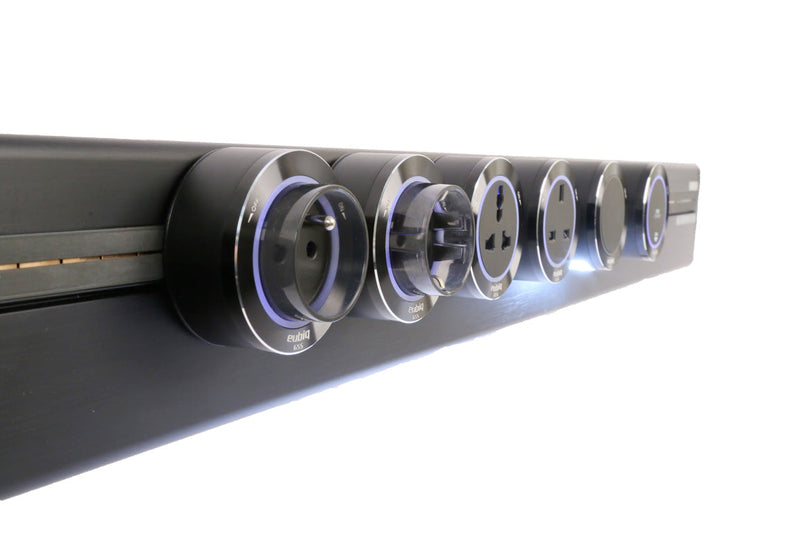
Eubiq sockets: modular, stylish and international
Eubiq power outlets are designed to fit all GSS system tracks. Available in titanium or black finishes, they offer an elegant and fully modular solution for distributing power according to your needs. Whether French, Schuko, British, or international sockets, or USB chargers: the Eubiq range allows you to freely configure your setup and adapt the number and type of outlets based on your usage. Kitchen, office, meeting room, hotel, or public space: simply add, move, or reposition your outlets exactly where you need them.
11 products
Sort by:
11 products


A coiled cord that connects directly to all Eubiq power tracks. Its extended length is 1.2 m. The cable ends with an IEC C5 "Mickey" connector. Electrical specifications: 220 V and 16 A. The red indicator light shows when power is supplied.
A cord for your connection
The CCS5 comes with a black coiled cable, unlike the PLT16, which is a cable-mount socket. It connects directly to all Eubiq power tracks and offers an extended cable length of 1.2 m.
Technical specifications
| Model | CCS5 |
| Type | Coiled cord |
| Brand | EUBIQ |
| Reference | 2040-0002-0412 |
| Voltage | 220 V |
| Current | 16 A |
| Indication | Red power-on indicator light |
| Cable | Black coiled |
| Extended cable length | 1.2 m |
| Indicated dimensions (L × W × H) | 32 × 14 × 1 cm |
| Cable termination | IEC C5 "Mickey" |
| Connection | All Eubiq power tracks |
Compatibility and connection
Eubiq cords, including the CCS5, as well as the PLT16 cable-mount socket, are compatible with all Eubiq power tracks. Observe the CCS5's 220 V and 16 A specifications as well as the manufacturer's instructions for the equipment to be connected.
Frequently asked questions
What does the number 5 mean?
The number 5 in CCS5 corresponds to the IEC C5 cable termination, also known as "Mickey", as with the CSP5-15.
What is the red indicator light for?
The red indicator light shows when power is supplied to the cord.
How does it differ from the PLT16?
The PLT16 is a cable-mount socket. The CCS5 is a cord with a black coiled cable that has an extended length of 1.2 m. Both are compatible with all Eubiq power tracks.
What are the electrical specifications?
The CCS5 is designed for a voltage of 220 V and a current of 16 A.
Does the 1.2 m length refer to the extended cable?
Yes, 1.2 m is the length when the coiled cable is extended.
What does it connect to?
The CCS5 connects directly to all Eubiq power tracks.
Follow the documentation for the cord and the track. For any work on the installation wiring, consult a qualified electrician and work with the power turned off.


A coiled cord that connects directly to all Eubiq power tracks. Its extended length is 1.2 m. The cable ends with an IEC C7 connector. Electrical specifications: 220 V and 16 A. The red indicator light shows when power is supplied.
A cord for your connection
The CCS7 comes with a black coiled cable, unlike the PLT16, which is a hardwired plug. It connects directly to all Eubiq power tracks and offers an extended cable length of 1.2 m.
Technical specifications
| Model | CCS7 |
| Type | Coiled cord |
| Brand | EUBIQ |
| Reference | 2039-0002-0412 |
| Voltage | 220 V |
| Current | 16 A |
| Indication | Red power indicator light |
| Cable | Black coiled |
| Extended cable length | 1.2 m |
| Indicated dimensions (L × W × H) | 32 × 14 × 1 cm |
| Cable termination | IEC C7 |
| Connection | All Eubiq power tracks |
Compatibility and connection
Eubiq cords, including the CCS7, as well as the PLT16 hardwired plug, are compatible with all Eubiq power tracks. Observe the 220 V and 16 A specifications of the CCS7 as well as the manufacturer's instructions for the equipment to be connected.
Frequently asked questions
What does the number 7 mean?
The number 7 in CCS7 corresponds to the IEC C7 cable termination. Similarly, the number 5 in CCS5 designates its IEC C5 "Mickey" termination.
What is the red indicator light for?
The red indicator light shows when power is supplied to the cord.
What is the difference with the PLT16?
The PLT16 is a hardwired plug. The CCS7 is a cord with a black coiled cable with an extended length of 1.2 m. Both are compatible with all Eubiq power tracks.
What are the electrical specifications?
The CCS7 is designed for a voltage of 220 V and a current of 16 A.
Does the length of 1.2 m correspond to the extended cable?
Yes, 1.2 m is the length indicated when the coiled cable is extended.
What does it connect to?
The CCS7 connects directly to all Eubiq power tracks.
Follow the documentation for the cord and the track. For any work on the installation wiring, consult a qualified electrician and work with the power turned off.


A coiled cord that connects directly to all Eubiq power tracks. Its extended length is 2.4 m and the cable ends with an IEC C13 connector. Electrical specifications: 220 V and 16 A. The red indicator light shows when power is supplied.
A cord for your connection
The CCS13 comes with a black coiled cable, unlike the PLT16, which is a cableable plug. It connects directly to all Eubiq power tracks and offers a cable length of 2.4 m when extended. The number 13 in its reference corresponds to its IEC C13 termination.
Technical specifications
| Model | CCS13 |
| Type | Coiled cord |
| Brand | EUBIQ |
| Reference | 2038-0002-0412 |
| Voltage | 220 V |
| Current | 16 A |
| Indication | Red power-on indicator light |
| Cable | Black coiled |
| Extended cable length | 2.4 m |
| Cable termination | IEC C13 |
| Indicated dimensions (L × W × H) | 32 × 14 × 1 cm |
| Connection | All Eubiq power tracks |
Compatibility and connection
Eubiq cords, including the CCS13, as well as the PLT16 cableable plug, are compatible with all Eubiq power tracks. Check that the IEC C13 termination matches the connector of the equipment to be connected. Respect the electrical specifications of the cord and the manufacturer's instructions.
Frequently asked questions
What does the number 13 mean?
The number 13 in CCS13 corresponds to the IEC C13 cable termination. Similarly, CCS5 designates an IEC C5 "Mickey" termination and CCS7 an IEC C7 termination.
What is the red indicator light for?
The red indicator light shows when power is supplied to the cord.
What is the difference with the PLT16?
The PLT16 is a cableable plug. The CCS13 comes with a black coiled cable, with an extended length of 2.4 m, ending in IEC C13. Both are compatible with all Eubiq power tracks.
What are the electrical specifications?
220 V and 16 A.
Does the length of 2.4 m correspond to the extended cable?
Yes, 2.4 m is the length indicated when the coiled cable is extended.
What does it connect to?
The CCS13 connects directly to all Eubiq power tracks.
Follow the documentation for the cord and the track. For any work on the installation wiring, consult a qualified electrician and work with the power turned off.
Showing 11/11
Find the ideal Eubiq power outlet for your installation
In 4 questions, we will precisely identify the type of outlet, format, and finish that suit your project. Whether for powering appliances, charging mobile devices, or connecting specific equipment, this guide will steer you toward the most appropriate solution.
Question 1 of 4
What is your main need?
Question 2 of 4
In what context will you be using this outlet?
Question 3 of 4
What is your priority for this installation?
Question 4 of 4
Do you need to connect a device located away from the track?
Our recommendations for you
Based on your answers, here are the products best suited for your project.
Multiplying power strips, hiding cables behind furniture, giving up on a room layout due to a lack of sockets in the right place... If you recognize any of these situations, it's probably because your sockets weren't designed for your actual usage.
And that's normal. Conventional installations were designed at a time when you plugged in a lamp, an alarm clock, and maybe a vacuum cleaner. Today, with smartphones, tablets, smart speakers, and an increasing number of kitchen appliances, the disconnect has become obvious. The idea here is to help you understand how the Eubiq modular socket system meets these new needs - and above all, how to choose the right configuration for your project, without any useless jargon.
Why the classic socket is no longer enough
Let's be honest: the problem isn't really the socket itself. It's its location, its number, and the fact that it is fixed in the wall for the next thirty years. Some situations you may have already experienced:
- The kitchen with a central island. You dream of a clean countertop, but the blender, kettle, and food processor have to be plugged in somewhere. The result: a power strip hanging down, or an island without any sockets because running a cable through the floor was too expensive.
- The shared office or open space. Every employee needs to power a monitor, a laptop, and a phone charger. The wall sockets are two meters away from the workstation, and extension cords get tangled underfoot.
- The hotel room. The guest looks for a socket near the bed to charge their phone. There is only one, behind the desk. And their American charger doesn't fit into the French socket.
- The meeting room. Six people around a table, six laptops to power, two wall sockets. Classic.
Added to these practical constraints is a dimension that is often underestimated: aesthetics. In a high-end design project - hospitality, retail, refined residential - a designer wall socket is an integral part of the decor. A cheap white socket on a waxed concrete wall ruins everything. And then there is this growing need for directly accessible USB ports, without having to stack power adapters.
It is precisely at this intersection of flexibility, aesthetics, and practicality that the Eubiq GSS system comes into play.
The Eubiq GSS system: what you need to understand before choosing
Before comparing the different sockets, let's take a minute to understand how it all works. Because the Eubiq system isn't just a prettier socket - it's a completely different logic for distributing electricity.
The power track principle
Imagine a track - discreet and made of aluminum - that is recessed into a wall or countertop, or mounted on the surface. This track distributes current along its entire length. And on this track, you clip sockets, USB chargers, and accessories exactly where you need them. No extra drilling, no calling the electrician back. You clip it on, it works. You unclip it, you reposition it. It's as simple as that.
Let's talk frankly about safety
The first question everyone asks - and it's a legitimate one: "A live track along its entire length, isn't that dangerous?" The answer is no, and that is the core of the GSS patent. The mechanism is designed so that no accidental electrical contact is possible, even when a position on the track is free. You cannot slip a finger, a metal object, or anything else in that would cause a short circuit. Current is only activated when an Eubiq socket is correctly clipped and locked in place. This is a fundamental point that distinguishes this system from simple industrial power strips.
Two families of products on the same track
The entire ecosystem is divided into two categories:
- Sockets - available according to national standards (French, European, international, British). Each one clips onto the same GSS track.
- Integrated USB chargers - which clip on in exactly the same way and allow you to charge your devices directly without a power adapter.
Finishes designed for integration
In terms of aesthetics, Eubiq offers several finishes: brushed aluminum, titanium, matte black. The choice of ring (aluminum or black plastic) and the presence of a discreet blue LED on the front allow each designer socket to be adapted to the atmosphere of a project. For a hotel using dark tones, the black version blends in effortlessly. For a contemporary office in light tones, brushed aluminum does the job. These are not details - in an interior design project, this kind of consistency makes the difference.
French, international, European, or British socket: what is the practical difference
This is where things become truly useful. Because on paper, all Eubiq sockets look alike - same compact format, same clip system. But they do not accept the same plugs and do not meet the same needs. Let's look at this by criteria rather than by product sheet.
Compatibility: which standard for which use
Each format corresponds to a national electrical standard:
- French socket (type E) - the plug with two round pins and a grounding pin on the socket. This is the residential standard in France. The French FR4 socket is the obvious choice if you are equipping a home, kitchen, or office in France with French appliances.
- European socket (type C) - two round pins, without grounding. Compatible with small, low-consumption devices (chargers, lamps, shavers). The European GS3 socket is well-suited for an office where you mainly plug in light devices.
- International socket - designed to accommodate multiple plug standards (European, American, etc.). The ITL3 and ITL4 versions are designed for spaces that host an international public: hotels, coworking spaces, conference rooms.
- British socket (type G) - three rectangular pins, the British standard. The British BS3 socket is aimed at export projects to the UK or establishments hosting British clients.
Finishes and visual details
The differences are not just technical. Take the international sockets: the black ITL3 with an aluminum ring offers an elegant contrast, while the black ITL4 with a black plastic ring plays the all-black card for even more discreet integration. The blue LED, present on all models, serves as a power indicator - practical in a dark room, and honestly quite pretty.
Moreover, for high-end hotel projects, the ITL3-L version in titanium finish provides a premium touch that does not go unnoticed.
Concrete use cases to help you decide
To simplify your choice:
- Are you equipping your apartment or house in France? The FR3 is your ally. No need to look any further to plug in your everyday appliances.
- Are you furnishing a hotel, an Airbnb, or a coworking space? The ITL3 or ITL4 will save you from having to provide adapters to every foreign visitor. It's a real plus in terms of customer experience.
- Do you mainly have light devices to plug in at the office? The European GS3 does the job with elegance, without the grounding pin you don't necessarily need for a charger or a desk lamp.
- Are you exporting a project to the United Kingdom? The BS3, quite simply.
Integrated USB charger or power cord: how to complete your installation
Sockets are the basics. But a modular system really makes sense when you add the right accessories. Two questions often come up: should you integrate a wall USB charger directly onto the track? And how do you power the track itself?
The USB3QC fast USB charger
The USB3QC charger clips onto the track exactly like a socket. Two USB ports, fast charging, blue LED. It is the ideal accessory for a bedside table (no more searching for the phone's power adapter), a workstation, or a meeting room. A wall-mountable USB charger that moves according to your needs - between us, it's still smarter than a USB-C wall charger permanently fixed to the wall.
Good to know: the power is calibrated for smartphones and tablets. For a power-hungry laptop, you will always need its own adapter plugged into a modular socket.
The CSP and CCS power cords
The track must be powered. That's the role of cords like the CSP5-15 (1.5m, matte black), which connects the track to an existing wall socket. Other references allow you to connect a device at a distance or adapt the installation to specific configurations. The choice depends mainly on the distance between your track and your power source.
A concrete configuration example
Imagine your kitchen backsplash: a GSS track recessed along the entire length, powered by a CSP cord. You clip on two French FR4 sockets for the food processor and the kettle, a USB3QC charger for the phone while you cook, and you keep space free to add a socket later if needed. No power strip, no trailing cables, and a clean line. That is what a well-thought-out modular socket allows.
Comparative table of Eubiq sockets and chargers
| Reference | Standard / Type | Compatibility | Finish | Recommended use |
|---|---|---|---|---|
| FR3/FR4 | French (type E) | French plugs with grounding | Black / black plastic ring / blue LED | Residential and tertiary in France |
| ITL3 | International | Multi-standard (EU, US…) | Black / aluminum ring / blue LED | Hospitality, coworking, international spaces |
| ITL4 | International | Multi-standard (EU, US…) | Black / black plastic ring / blue LED | Same as ITL3, all-black finish |
| GS3 | European (type C) | European 2-pin plugs | Aluminum ring / blue LED | Office, light appliances |
| BS3 | British (type G) | British 3-pin plugs | Aluminum ring / blue LED | UK projects, British clientele |
| USB3QC | USB Charger | Smartphones, tablets (fast charge) | Blue LED | Bedside table, workstation, meeting |
| CSP5-15 | Power cord | GSS track power supply | Matte black / 1.5 m | Connecting track to an existing socket |
All these elements clip onto the same GSS track, regardless of its format (recessed or surface-mounted) or length.
Choosing well starts with defining your need
Ultimately, the logic for choosing comes down to three steps. First, identify your electrical standard: French for domestic use in France, international if you host foreign visitors. Then, ask yourself if an integrated USB charger would make your life easier - spoiler: in 90% of cases, yes. Finally, choose the finish that integrates into your project without aesthetic compromise.
The real advantage of the modular system is that it forgives foresight errors. You can evolve your installation without work, add a socket here, move a charger there, according to your needs. It is a designer wall socket that adapts to you, not the other way around.
Do not hesitate to browse the entire range to find the combination that corresponds exactly to your project.
Frequently asked questions about Eubiq sockets
What is the difference between a French and an international Eubiq socket?
The French socket only accepts type E plugs - those with two round pins and a grounding pin, the standard in France. The international socket (ITL3 or ITL4) is designed to accommodate several plug formats: European, American, and other common standards. If you are equipping a home in France, the FR4 is sufficient. If you are furnishing a hotel or a space hosting foreign visitors, opt for the ITL to avoid the chore of adapters.
What are the benefits of a wall USB charger integrated into the track?
The main advantage is the complete elimination of the power adapter. The USB3QC charger clips onto the track, offers two USB ports with fast charging, and does not monopolize a socket position. You can also move it along the track according to your needs - practical when you rearrange a space. It's a real space and practicality saver on a daily basis.
Why choose a modular socket rather than a conventional wall socket?
Flexibility, above all. With the GSS system, you add, remove, or move a socket without tools and without calling an electrician. The security patent guarantees that no accidental contact is possible on the free positions of the track. A concrete example: you are rearranging your office and adding a workstation? You clip on an additional socket in thirty seconds. Try doing that with a conventional wall socket.
Can you mix sockets and USB chargers on the same Eubiq track?
Yes, that is precisely the principle. On the same GSS track, you can freely combine French, international, and European sockets, USB chargers, and cords. The only limit is the total power of the electrical circuit powering the track. In practice, for common use (a few office or kitchen appliances), you are well within the limits.
What is the power of an Eubiq wall USB charger?
The USB3QC offers two USB ports with fast charging (Quick Charge). This is sufficient to efficiently charge a smartphone or tablet - comparable to, or even better than, most conventional wall USB chargers. However, for a laptop that requires 65W or more, you will need to use its own adapter plugged into a socket. It's worth knowing before.
Are Eubiq sockets compatible with all GSS tracks?
Yes. All Eubiq sockets and accessories are compatible with all GSS tracks, whether they are recessed, surface-mounted, short, or long. The choice of track depends on your installation configuration (type of wall, furniture, desired length), but it has no impact on the choice of sockets. You can therefore select your sockets and chargers independently of the track.
Collections featured


The French specialist in designer electrical tracks since 2008. Exclusive Eubiq importer in Europe — Dilectro Ltd.
The French specialist in designer electrical tracks since 2008. Exclusive Eubiq importer in Europe — Dilectro Ltd.